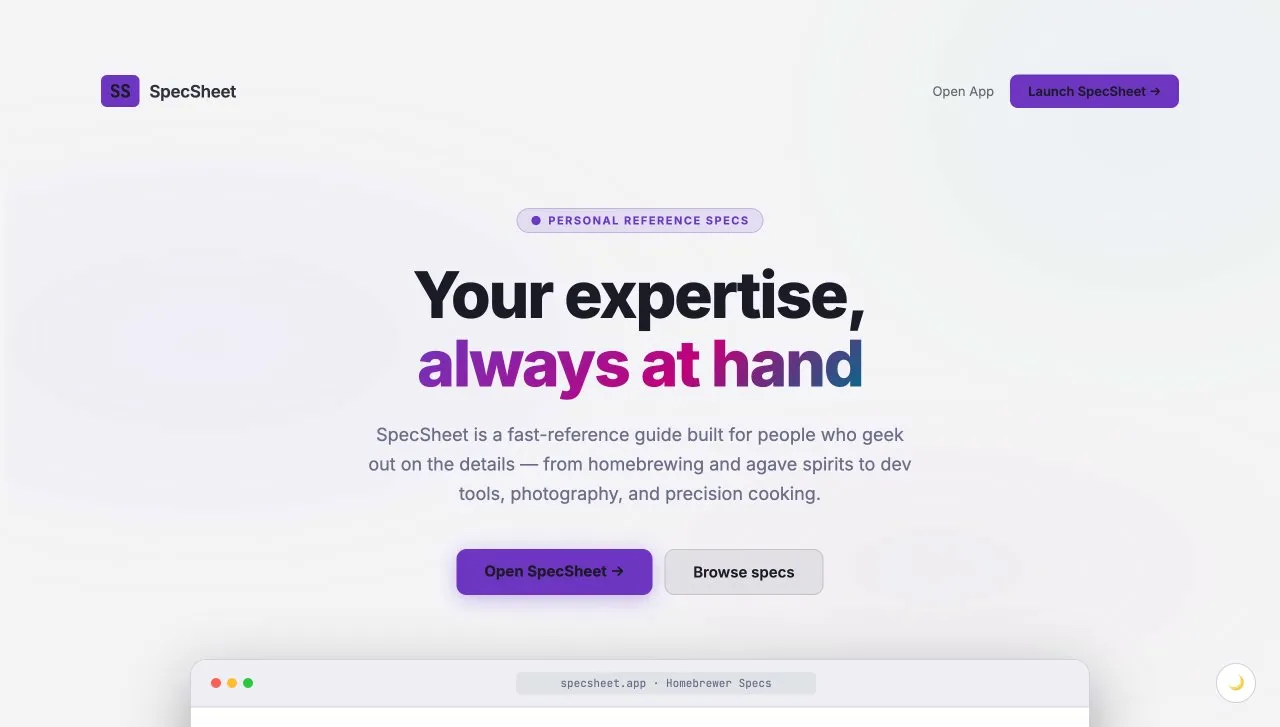
The idea
Some people pick up a hobby and want to understand it all the way down. They don't just ask how to make coffee. They want to know their target extraction yield percentage. They want to know what the Maillard reaction does during roasting and exactly how water hardness affects flavor. I am that kind of person across more hobbies than is probably healthy.
What I found myself doing repeatedly was opening the same bookmarks, the same Reddit wikis, the same saved notes every time I needed to look up a specific number or formula in the middle of doing the thing. Mash temperature for a pale ale. Pitching rate for a lager. Yeast ABV tolerance for a high-gravity fermentation. These are not things you memorize. They are things you look up.
SpecSheet is the app I wanted to exist for that. A single place where the specs for all of my interests live, instantly searchable, always accessible.
What it covers
The current spec sets span:
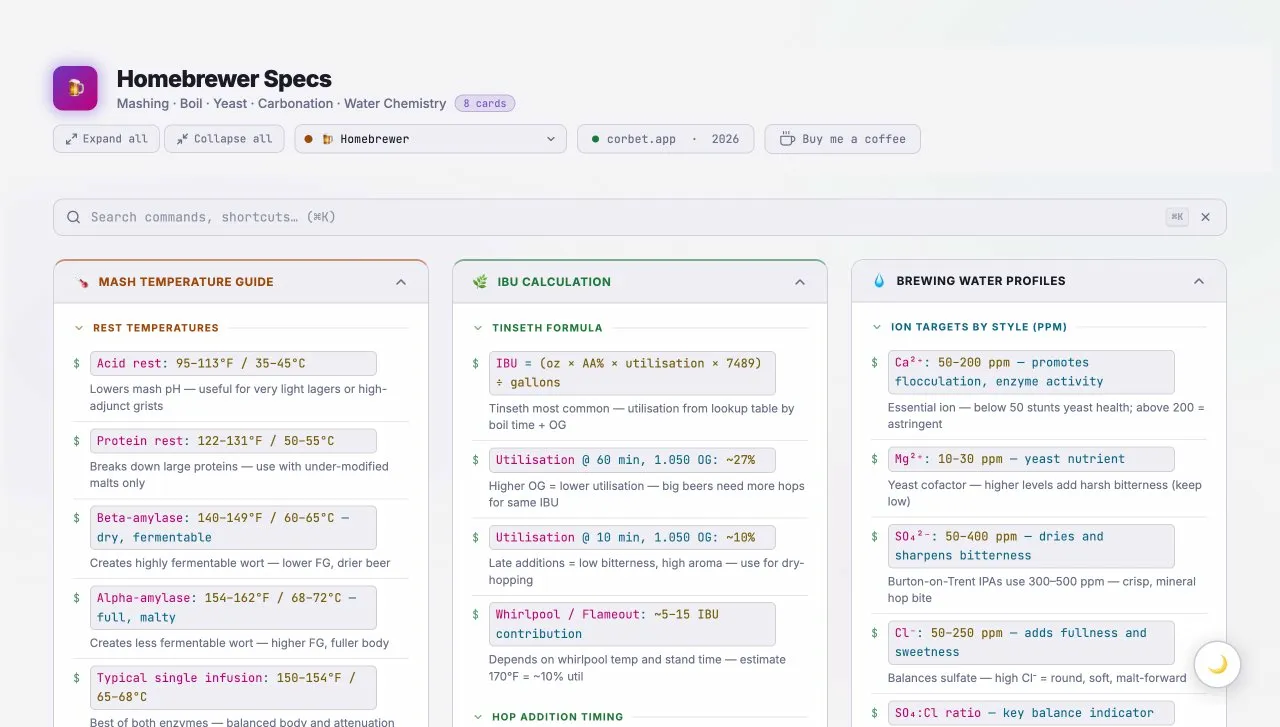
- Brewing and spirits: homebrewing formulas, craft beer style guides, home distilling reference, craft mixology specs, agave spirits (tequila and mezcal production, aging categories, denomination rules), and rum production and classification
- Food and coffee: coffee brewing ratios and extraction targets for every brew method, coffee variety and origin reference, and home chef temperature and timing guides
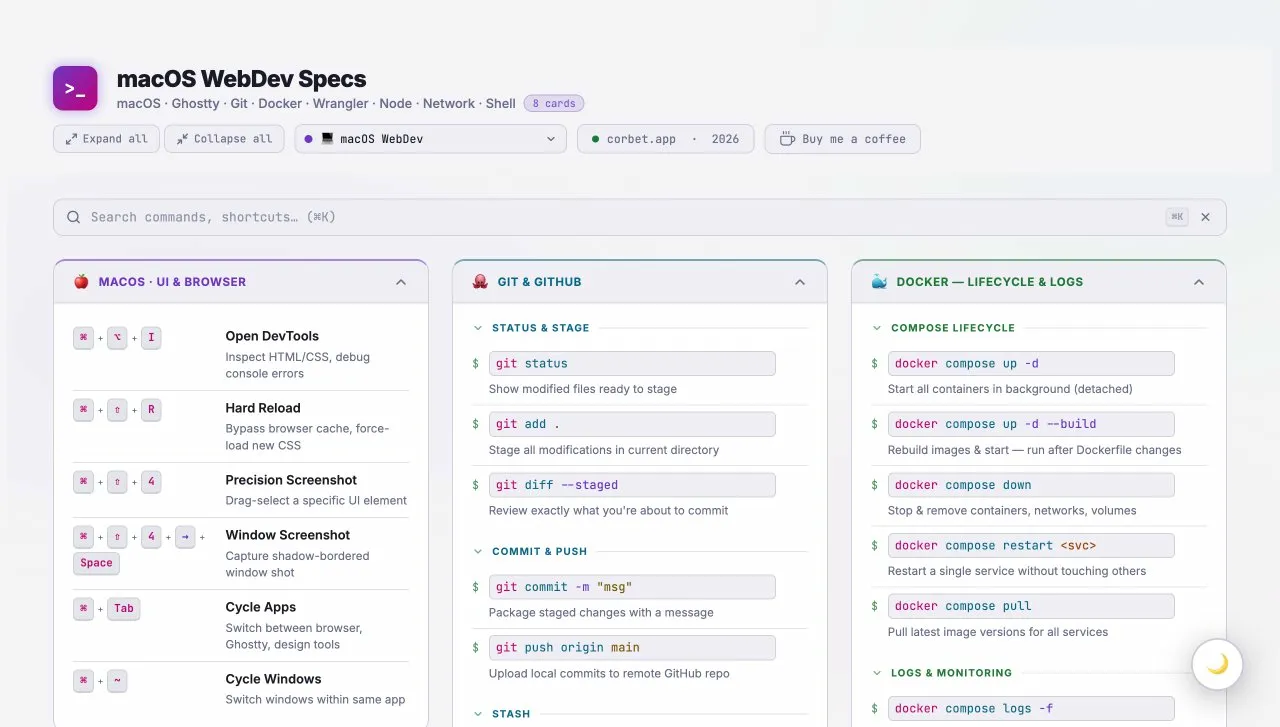
- Tech: macOS web development environment reference, UI/UX design system specs, product management frameworks, business analysis templates, and QA testing checklists
- Hobbies: retro gaming hardware specs, photography exposure and lens reference, 3D printing settings, fashion sizing and fabric reference, and cannabis cultivation and terpene guides
Each spec set is a curated collection of cards. A card is a specific reference item: a formula, a table, a checklist, a set of recommended values. They are written to be useful to someone who already knows the domain and just needs the number, not to someone who needs everything explained from scratch.
How it works technically
SpecSheet is a static vanilla JS app deployed on Cloudflare Pages. There is no backend, no database, no account system. All spec content lives in the JavaScript source as structured data objects.
Full-text search runs client-side with Cmd+K, matching across every card in every spec set. It highlights matches inline rather than navigating to a separate results page. This keeps the experience fast and keeps the context of what you were looking at intact.
Each spec set has a unique URL fragment (for example, specs.uihub.app/specs#homebrewer), so you can bookmark or share a specific section and land exactly there. Dark and light mode follow system preference automatically and can be toggled manually with the preference persisted to localStorage.
Every command and formula in the app has a one-click copy button that writes the raw text to the clipboard without any surrounding HTML. This is a small thing that matters when you are in the middle of a brew session and need to paste a value into a calculator.
Why no login
SpecSheet does not have user accounts because the spec content is not personal data. The specs are reference material that is the same for everyone who needs them. Adding accounts would add friction, a privacy obligation, and infrastructure costs without adding any value to what the app actually does.
The only thing stored per-user is their dark mode preference, which lives in localStorage and goes nowhere.
Open it at specs.uihub.app. Hit Cmd+K and search for something you care about.